Short answer: Your Feng Shui Kua number — also called your ming gua or personal trigram — is a single digit from 1 to 9 (the digit 5 is never used) calculated from your birth year and your sex. It assigns you to one of two groups, East or West, and identifies four favourable directions you can apply to your bed, your desk, and your front door. This guide gives you the exact formula, a quick-reference group chart, the four “good” directions for each number, and the mistakes that most often produce the wrong result.
By the NimbusCalc Editorial Team · Last reviewed November 2026 · Reading time: about 8 minutes
Key takeaways
– The Kua number is based on the Chinese solar year, so a January or early-February birthday often belongs to the previous year.
– Men and women use different arithmetic, and the missing digit 5 is reassigned — to 2 for men and 8 for women.
– Kua 1, 3, 4 and 9 are the East Group; 2, 6, 7 and 8 are the West Group.
– The result is a directional tool, not a prediction of wealth, health, or romance.
What Is a Feng Shui Kua Number?
A Kua number is a core concept of the Ba Zhai (Eight Mansions) school of Feng Shui, a system that classifies people and buildings by eight trigrams derived from the I Ching. Each trigram corresponds to a compass direction, an element, and a number from 1 to 9. Your personal number is meant to describe which of the eight directions are supportive for you and which are less favourable.
The number is sometimes written as “Gua number,” “Ming Gua,” or simply “Kua,” and all three refer to the same single digit. It is not the same as a life path number in numerology, nor is it your Chinese zodiac animal — those come from different systems, even though all three begin with a birth date. Confusing them is one of the most common reasons people end up with an incorrect reading.
In traditional practice the digit 5 has no trigram of its own. When a calculation lands on 5, it is converted: a man’s 5 becomes 2 and a woman’s 5 becomes 8. This is why a valid Kua number is always one of 1, 2, 3, 4, 6, 7, 8 or 9, and why any calculator that returns 5 is incomplete.
It is worth stating plainly what a Kua number is not. It is a framework within a centuries-old cultural tradition, not a scientific measurement, and no controlled study establishes that facing a given compass direction changes financial or romantic outcomes. Used as a reflective tool for arranging a space, it is harmless and, for many people, meaningful. Used as a substitute for financial, medical, or relationship advice, it is not appropriate. We return to this point in the disclaimer at the end.
How to Calculate Your Kua Number by Birth Year (Step by Step)
The calculation has three stages: fix the correct birth year, reduce it to a single digit, then apply the sex-specific formula. Because different lineages of Eight Mansions Feng Shui use slightly different formulas for people born in 2000 or later, the most reliable approach is to let a calculator apply one rule set consistently. You can use the free Feng Shui home audit tool on NimbusCalc, which applies Kua number, facing-direction and Flying Star rules in one place, to skip the arithmetic entirely, and browse the full calculator directory for related tools. The manual method below follows the widely taught pre-2000 convention.
Step 1 — Confirm the correct Feng Shui year. Eight Mansions uses the Chinese solar year, which begins at Li Chun (the “Start of Spring,” usually 3–5 February), not on 1 January and not on the lunar New Year. If you were born in January or in the first days of February, your Feng Shui birth year is the previous calendar year. A person born on 28 January 1990, for example, is treated as a 1989 birth for this purpose.
Step 2 — Reduce the year to one digit. Add the four digits of the (adjusted) birth year and keep adding the digits of the result until a single digit remains. For 1989: 1 + 9 + 8 + 9 = 27, then 2 + 7 = 9. The reduced digit is 9.
Step 3 — Apply the formula for your sex. For a man, subtract the reduced digit from 11 (for 2000-onward births, many schools use 9 instead). For a woman, add 4 to the reduced digit (for 2000-onward births, many schools use 6). Reduce any two-digit answer to a single digit again. Using the 1989 example: a man gets 11 − 9 = 2; a woman gets 9 + 4 = 13, reduced to 1 + 3 = 4.
Step 4 — Handle the digit 5. If the result is 5, convert it: men become 2, women become 8. No other adjustment is needed.
Two people born in the same year but of different sexes will therefore usually have different Kua numbers, which is expected. If your hand calculation and a calculator disagree, the usual causes are the Li Chun boundary, a two-digit sum that was not reduced a second time, or a 2000-onward formula mismatch. When in doubt, trust a single consistent calculator rather than mixing rules from different sources.
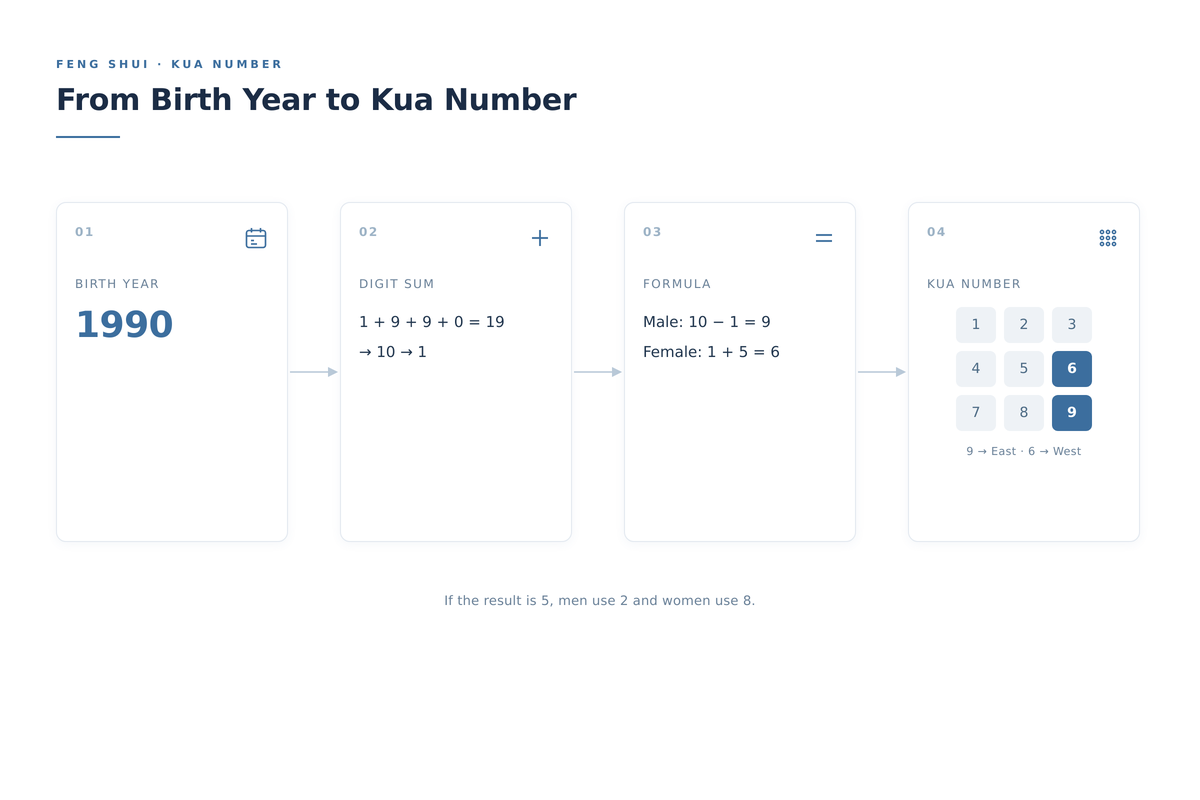
Figure 1. The four-stage calculation from birth year to Kua number.
Kua Number Groups and Best Directions (Quick-Reference Chart)
Once you have your digit, the table below tells you your group and your four favourable directions. “Favourable” here means the directions a practitioner would try to face or have behind them while sleeping, working, or sitting — not a guarantee of any outcome.
| Group | Kua numbers | Favourable directions (compass) | Less favourable directions |
|---|---|---|---|
| East Group | 1, 3, 4, 9 | North, East, Southeast, South | West, Northwest, Southwest, Northeast |
| West Group | 2, 6, 7, 8 | West, Northwest, Southwest, Northeast | North, East, Southeast, South |
The eight trigrams behind these groupings are fixed: Kan (1, North), Kun (2, Southwest), Zhen (3, East), Xun (4, Southeast), Qian (6, Northwest), Dui (7, West), Gen (8, Northeast) and Li (9, South). The centre, 5, has no direction, which is exactly why it is reassigned. Notice that the two groups are mirror images: every direction that supports one group is listed as unfavourable for the other.
East Group vs. West Group: What Your Number Actually Means
Your group is the practical output of the whole calculation. East Group people — Kua 1, 3, 4 and 9 — are traditionally advised to orient themselves toward North, East, Southeast or South. West Group people — Kua 2, 6, 7 and 8 — are advised to orient toward West, Northwest, Southwest or Northeast. In the Eight Mansions system a person and a building are both classified this way, and a “matching” house is one whose facing direction suits the occupant’s group.
Within your four good directions, classical texts rank them by purpose. One is associated with vitality and career momentum, another with health and recovery, a third with relationships and longevity, and the fourth with stability and calm. Different English translations use different names for these — Sheng Qi, Tian Yi, Yan Nian and Fu Wei are the common romanisations — so you will see them labelled inconsistently across sources. What matters for everyday use is simpler: all four are considered supportive, and any of them is a reasonable choice for a desk, a bed, or the direction you face while seated.
A frequent misunderstanding is that a “bad” direction must be avoided at all costs. In practice, most practitioners treat the unfavourable set as a lower priority, not a prohibition. Real rooms have windows, doors, and load-bearing walls that rarely line up with an ideal compass point. Treat the chart as a gentle preference to apply where you have a choice, rather than a rule that requires you to rebuild a room.
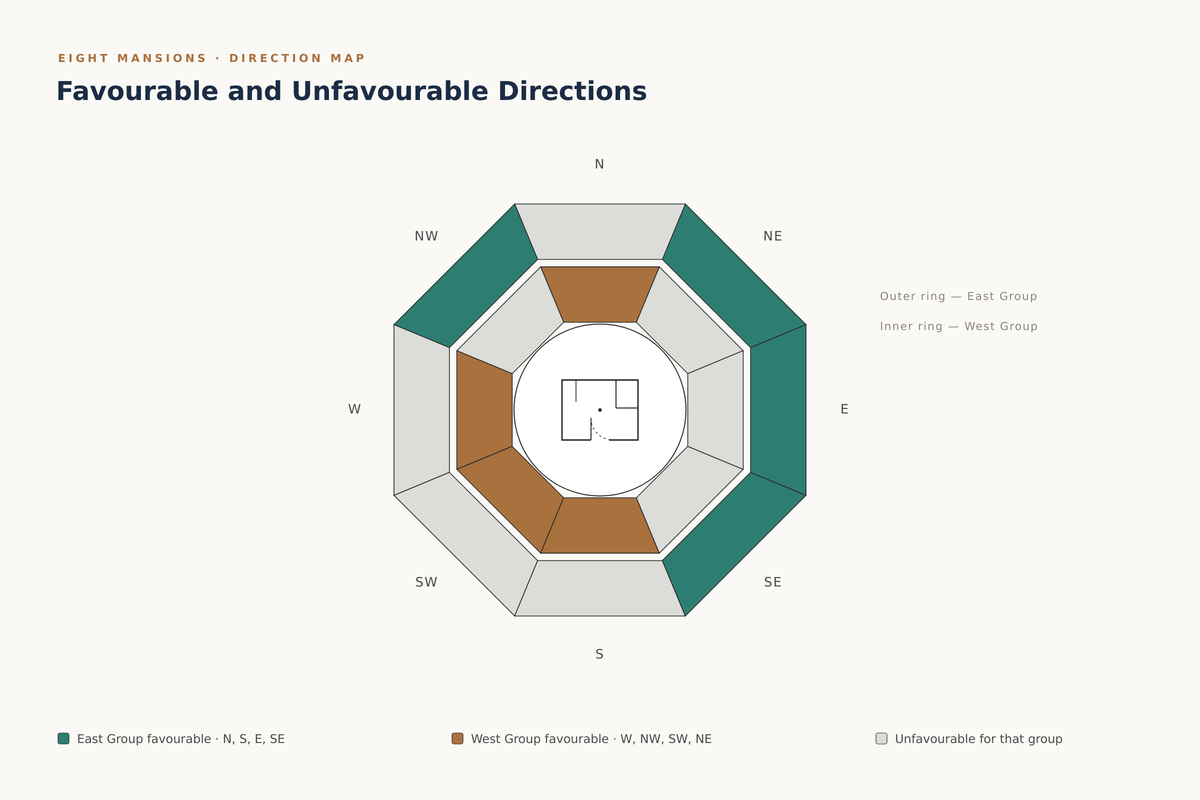
Figure 2. East Group and West Group directions on a compass.
How to Use Your Four Best Directions at Home and at Work
The three placements most often discussed are the bed, the desk, and the main entrance.
Sleeping. The classic advice is to have your head point toward one of your favourable directions while you sleep. Measure with a compass app well away from metal furniture and electronics, since nearby metal distorts the reading. If the bed cannot be moved, a small change such as the orientation of the pillow is a common compromise.
Working. For a desk, the advice is usually to face a favourable direction, or to have a supportive direction behind you as “backing” while you sit. If two people share a home office and belong to different groups, prioritise the person who spends more hours at the desk, or choose the direction that works for the room’s layout and treat the rest as secondary.
Entrances and seating. The front door is read as the “mouth” of the home in Eight Mansions, so its facing direction is weighted heavily in a full consultation. For a quick personal check, focus on the chair where you read, study, or take calls. Small, reversible experiments — turning a chair, moving a desk a few degrees — are a sensible way to test whether the arrangement feels better to you, without any construction.
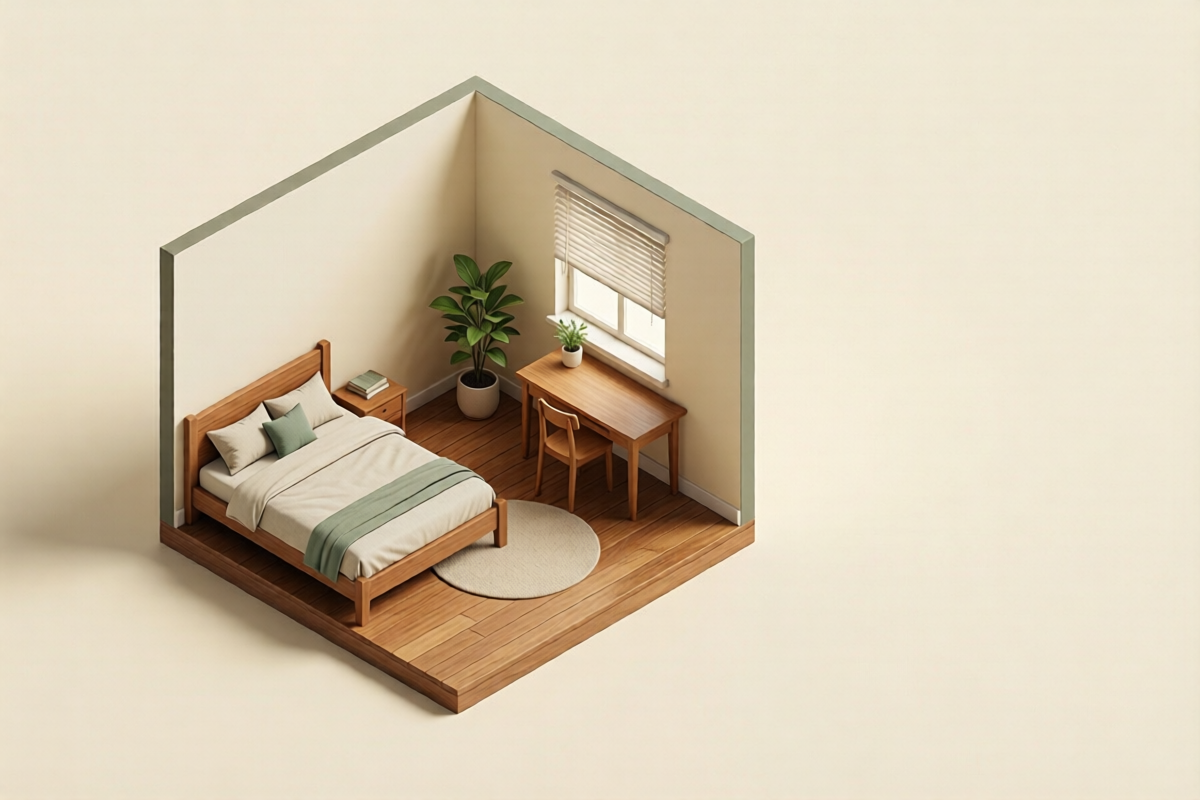
Figure 3. A bed and desk oriented toward a favourable direction.
Keep expectations proportionate. Rearranging a desk may make a room feel more intentional and pleasant; it should not be expected to change your income or your luck. If you enjoy the reflective side of the practice, our broader guide to the tradition, Feng Shui: The First Study — The 3,000-Year-Old Blueprint for Wealth, Love & Luck, places these directional rules in their historical context.
Common Mistakes When Calculating Your Kua Number
Using 1 January as the year boundary. As noted above, the Feng Shui year turns at Li Chun in early February. January and early-February birthdays are the single biggest source of off-by-one errors.
Forgetting the sex-specific formula. Adding 4 for a man or subtracting from 11 for a woman inverts the result. Always confirm which formula your source uses.
Leaving a two-digit sum unreduced. A result of 13 or 11 must be reduced again (1 + 3 = 4). Stopping early produces a number that does not exist in the system.
Accepting 5 as an answer. A calculator that returns 5 has skipped the reassignment step. Convert to 2 (men) or 8 (women).
Mixing pre-2000 and post-2000 rules. Schools disagree on the formula for 2000-onward births. Pick one convention and apply it consistently rather than combining steps from two guides.
Confusing Kua with numerology or zodiac. A life path number and a Chinese zodiac sign are different systems with different inputs and outputs. Cross-checking them against each other will not validate a Kua result.
Being honest about these limits is part of using the tool well. The Eight Mansions formulas are internally consistent as a cultural system, but they are not standardised across all lineages, and no authoritative body certifies one version as correct. Where sources disagree, say so and show which convention you followed — as this guide does — instead of presenting a single number as unquestionable fact.
Frequently Asked Questions About Kua Numbers
What is a Feng Shui Kua number in one sentence?
A single digit from 1 to 9 (never 5), derived from your birth year and sex, that identifies your East or West Group and four favourable compass directions in the Eight Mansions tradition.
Can my Kua number change?
No. It is fixed at birth under a given formula. What changes is how you apply it — a new home or a new desk simply gives you different opportunities to use the same four directions.
Is the Kua number the same as my Chinese zodiac sign?
No. The zodiac is a 12-year animal cycle based on the lunar year; the Kua number is an Eight Mansions trigram based on a reduced year digit and sex. Both use your birth date but answer different questions.
Which direction should I face while working?
Choose one of your four favourable directions from the table above. East Group: North, East, Southeast, South. West Group: West, Northwest, Southwest, Northeast. All four are considered supportive.
Why is there no Kua number 5?
The centre position of the eight-trigram arrangement has no compass direction, so 5 is reassigned to 2 for men and 8 for women.
Do I need a special compass?
A smartphone compass is sufficient for a rough reading. Take the measurement away from metal frames, speakers, and wiring, and average a few readings rather than relying on one.
Does facing a good direction actually improve my luck?
There is no scientific evidence that orientation changes objective outcomes. Treat the practice as a cultural framework for arranging space thoughtfully, not as a causal lever for wealth or relationships.
Want the full picture behind the numbers? The Eight Mansions system is one chapter of a much older tradition connecting spatial arrangement to ideas about wealth, love, and fortune. For the historical background and the wider framework, see Feng Shui: The First Study — The 3,000-Year-Old Blueprint for Wealth, Love & Luck, which expands on the concepts introduced here.
Disclaimer: Feng Shui and Kua number readings are provided for cultural, educational, and entertainment purposes only and are not financial, medical, legal, or professional advice.
Explore the full series: Feng Shui Bagua Map: How to Find the Wealth Corner of Your Home · Best Sleeping Direction According to Feng Shui (by Kua Number) · Feng Shui Front Door Direction: How to Find Your Home’s Facing · BaZi Four Pillars: A Beginner’s Guide to Your Birth Chart · Life Path Number Calculator: How to Find Yours and What It Means · How to Find Your Lucky Numbers Using Your Date of Birth · Personal Year Number Calculator: How to Find Yours for This Year · Name Number Numerology Calculator: How to Convert Your Name into Numbers · Chinese Zodiac Compatibility Calculator: Are You and Your Partner a Match?.