Short answer: To check Chinese zodiac compatibility, first find each person’s birth-year animal using the lunar-new-year boundary (not 1 January), then compare the two animals with the traditional “three harmonies” (san he), “six harmonies” (liu he) and the six-year clash (liu chong). Animals four years apart form a harmony trine, animals six years apart form the classic clash, and a handful of adjacent-secret-friend pairs are read as especially easy matches.
Key takeaways
– The Chinese zodiac is a twelve-year cycle of animals paired with the twelve earthly branches, not a monthly sun-sign system.
– The year boundary falls at the lunar new year (or, in some schools, at Li Chun, “Start of Spring,” in early February); January and early-February births are frequently assigned the wrong animal.
– The core matching rules are four “three-harmony” trines, six “six-harmony” pairs and six opposing “clash” pairs.
– A full BaZi (Four Pillars) reading uses birth year, month, day and hour; animal-to-animal matching is a much simpler folk shorthand.
– Zodiac compatibility is cultural heritage and entertainment, not evidence about relationship outcomes.
What Is Chinese Zodiac Compatibility?
The Chinese zodiac, or shengxiao, assigns one of twelve animals to each year in a repeating cycle: Rat, Ox, Tiger, Rabbit, Dragon, Snake, Horse, Goat (Sheep), Monkey, Rooster, Dog and Pig. Each animal is paired with one of the twelve earthly branches, and the branches carry further associations with elements, directions and double-hour periods. Compatibility reading asks a narrow question: given two animals, how do their branches relate?
The traditional answers come from branch relationships, not from the animals’ personalities. Three branches form a “three-harmony” trine (san he), certain pairs form a “six-harmony” (liu he) bond, and branches directly opposite on the circle form a “clash” (liu chong) or, in some texts, a “harm” or “punishment.” Popular retellings translate these into character language — the Dragon is bold, the Rabbit is gentle — but the underlying rules are positional: they are about where the two branches sit on the twelve-part cycle.
If you want to see the idea turned into an interactive report, the zodiac compatibility checker for love and friendship produces a reading from two birth years, and the full calculator directory lists related tools.
How to Find Your Chinese Zodiac Animal (Step by Step)
Step 1 — Get the full birth date, including the year. The animal is assigned by year, so the year matters most; the month and day matter only for the boundary case below.
Step 2 — Check the lunar new year for that year. The zodiac year does not start on 1 January. It starts at the lunar new year, which falls between late January and mid-February. Some BaZi schools use Li Chun (usually 3–5 February) instead. Someone born on 20 January 1990, for example, still belongs to the previous Snake year, not the Horse year.
Step 3 — Match the year to the animal. A quick anchor: 2024 was the Year of the Dragon, so 2000, 2012 and 2036 are also Dragon years. Add or subtract twelve from any known year, or use modulo arithmetic — years with (year − 4) mod 12 == 8 are Dragon years in the common Gregorian-lunar approximation.
Step 4 — Repeat for the second person. Multiply-check both boundary cases; a January or early-February birthday is the most common source of a wrong result.
Step 5 — Compare positions on the cycle. Count the steps between the two animals. Four steps (in either direction within a trine) suggests a three-harmony group; six steps is the direct opposition, the clash; one-step-adjacent pairs belong to the six-harmony set in some groupings.
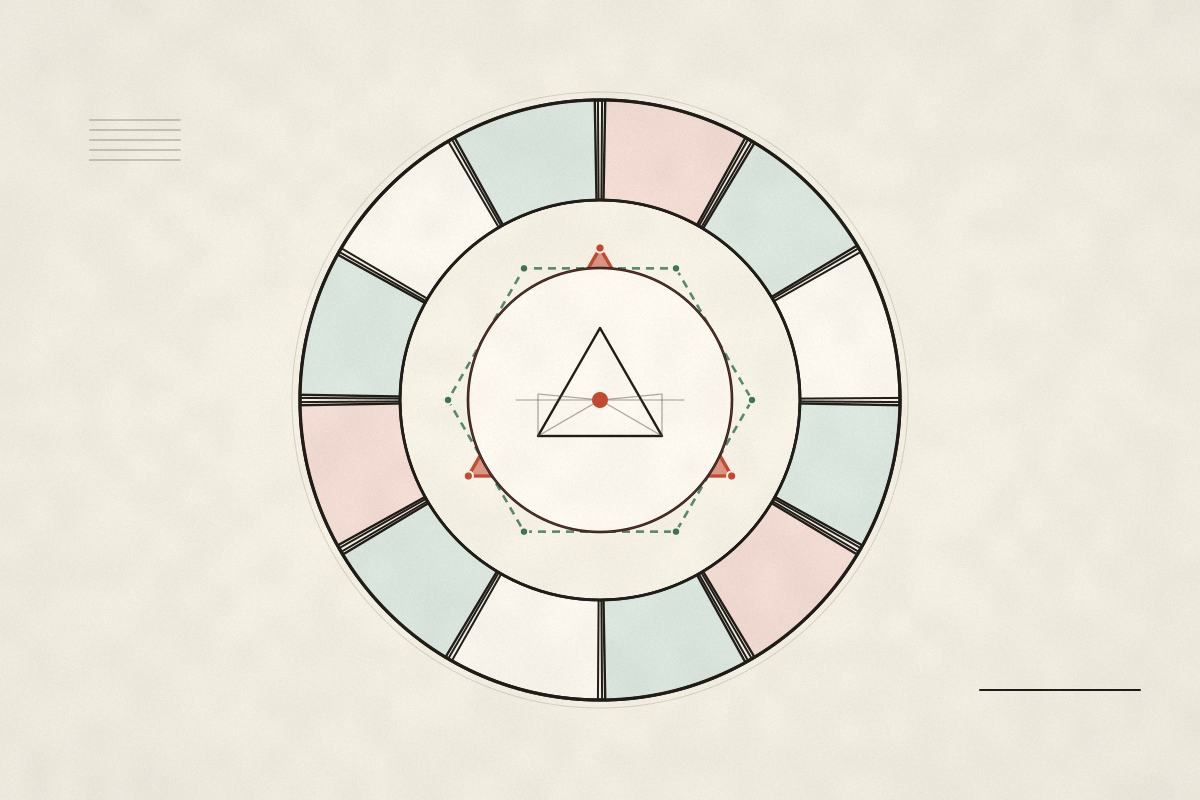
Figure 1. Affinity groupings drawn as a triangle and a hexagon over the twelve-segment ring.
The Compatibility Rules: San He, Liu He and Liu Chong (Quick-Reference Chart)
The table below gives the standard groupings. “Favourable” and “challenging” here mean “how the tradition labels them,” not predictions.
| Relationship | Rule | Pairs / groups |
|---|---|---|
| Three harmonies (san he) | Four trines, each three animals four years apart | Rat–Dragon–Monkey; Ox–Snake–Rooster; Tiger–Horse–Dog; Rabbit–Goat–Pig |
| Six harmonies (liu he) | Six “secret friend” pairs | Rat–Ox; Tiger–Pig; Rabbit–Dog; Dragon–Rooster; Snake–Monkey; Horse–Goat |
| Six clashes (liu chong) | Six directly opposite pairs, six years apart | Rat–Horse; Ox–Goat; Tiger–Monkey; Rabbit–Rooster; Dragon–Dog; Snake–Pig |
| Same animal | Twelve years apart | Read as “similar temperament,” sometimes as too much of the same |
A pair can appear in more than one list depending on the source, and some systems add “harm” (liu hai) and “punishment” (xing) sets that complicate the picture further. That proliferation is itself a useful caution: there is no single authoritative scoring table.
The Twelve Animals at a Glance
| # | Animal | Branch | Recent years |
|---|---|---|---|
| 1 | Rat | Zi | 2020, 2008, 1996 |
| 2 | Ox | Chou | 2021, 2009, 1997 |
| 3 | Tiger | Yin | 2022, 2010, 1998 |
| 4 | Rabbit | Mao | 2023, 2011, 1999 |
| 5 | Dragon | Chen | 2024, 2012, 2000 |
| 6 | Snake | Si | 2025, 2013, 2001 |
| 7 | Horse | Wu | 2026, 2014, 2002 |
| 8 | Goat | Wei | 2027, 2015, 2003 |
| 9 | Monkey | Shen | 2028, 2016, 2004 |
| 10 | Rooster | You | 2029, 2017, 2005 |
| 11 | Dog | Xu | 2030, 2018, 2006 |
| 12 | Pig | Hai | 2031, 2019, 2007 |
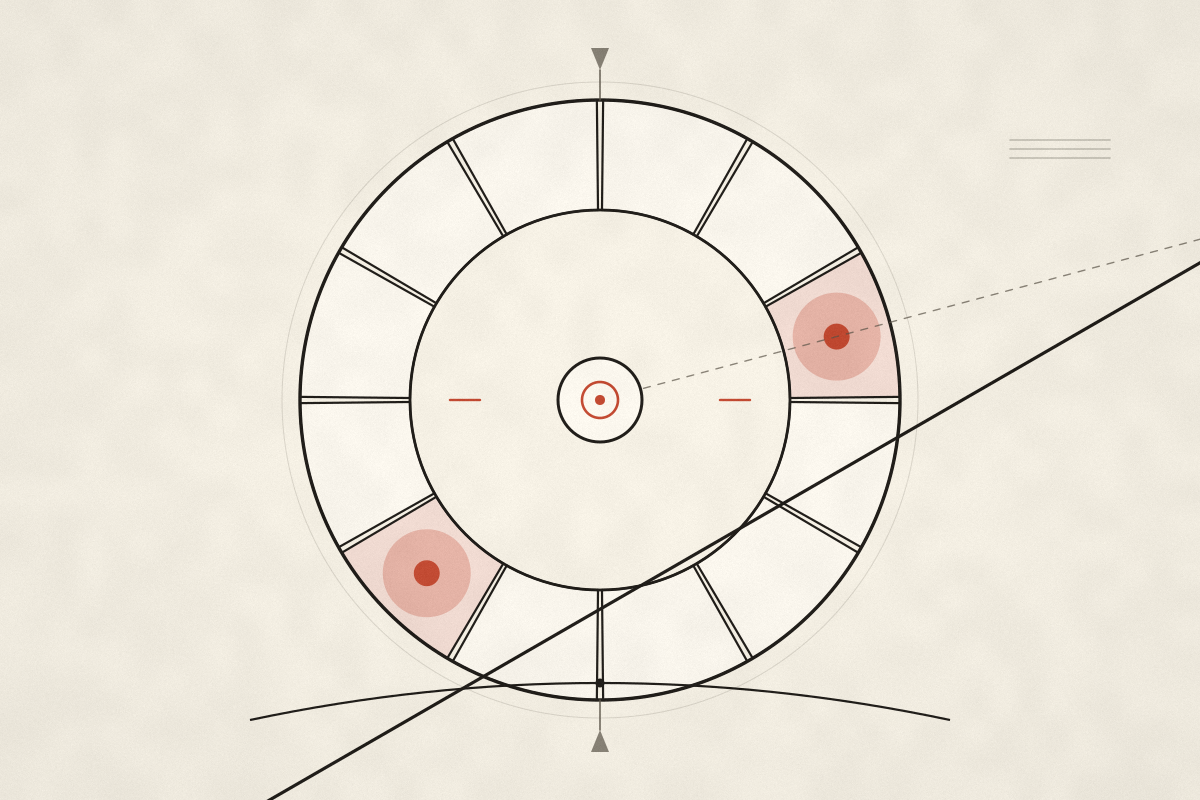
Figure 2. The six-year opposition drawn as a crossing axis through the ring.
From Animal Matching to BaZi: What a Full Reading Adds
Animal-to-animal matching uses exactly one data point: the birth-year branch. A full BaZi (Four Pillars of Destiny) chart uses four — the year, month, day and hour of birth, each expressed as a heavenly stem and an earthly branch — and reads their interactions, the five phases (wood, fire, earth, metal, water), and the day master. Two people whose animals “clash” may have plenty of balancing elements elsewhere in their charts, and vice versa. A companion article on BaZi covers that fuller method; this one deliberately stays with the folk shorthand most calculators implement.
The practical upshot: if you enjoy the tradition, use the animal match as a conversation starter, not a verdict. Two people with a “clash” pairing have built perfectly ordinary lives together for centuries, which is exactly what you would expect if the rule had no predictive power.
Figure 3. A paired reading, drawn as two silhouettes in balance.
Common Mistakes in Zodiac Compatibility
Using 1 January as the year boundary. This is the most frequent error. Always check the lunar-new-year date for the specific year.
Assuming the animal repeats every twelve Gregorian years exactly. It repeats every twelve lunar-cycle years; the boundary drift means a January birthday can fall on either side.
Treating the animal as a personality type. Popular descriptions are folklore layered on top of the branch system, not the system itself.
Stacking incompatible rule sets. San he, liu he, liu chong, liu hai and xing come from different texts and different schools. Adding them into one “score” without saying which you used produces an arbitrary number.
Confusing zodiac matching with BaZi. One is a single-branch comparison; the other is a four-pillar chart. They are not interchangeable, and a zodiac result cannot be “upgraded” by adding a birth hour.
Reading a clash as a prediction. It is a symbolic label from a cultural tradition, not a statement about a real relationship.
Frequently Asked Questions About Chinese Zodiac Compatibility
Which Chinese zodiac signs are most compatible? In the traditional lists, the three-harmony trines (for example Rat–Dragon–Monkey) and the six-harmony pairs (for example Rabbit–Dog) are labelled the easiest matches. These are conventional labels, not measured outcomes.
What is the six-year clash? Animals exactly six positions apart on the cycle — Rat–Horse, Ox–Goat, Tiger–Monkey, Rabbit–Rooster, Dragon–Dog, Snake–Pig — sit opposite one another and are called chong, “clash.”
I was born in January — which animal am I? Usually the animal of the previous lunar year. Look up that year’s lunar new year date; if your birthday falls before it, you belong to the preceding animal. Some BaZi schools use Li Chun instead and may differ by a few days.
Do the elements matter? In full BaZi, yes — each year also carries a heavenly stem and element. In simple animal matching they are usually ignored.
Is Chinese zodiac compatibility the same as Western astrology? No. Western astrology uses twelve monthly sun signs; the Chinese cycle is annual and branch-based, with a different set of relationships.
Can I get a report from two birth years? Yes — the love and friendship zodiac compatibility checker generates one from two birth years.
Is there any scientific basis? No. Controlled studies do not support links between birth-year animals and relationship outcomes. Treat it as heritage and entertainment.
Further Reading and a Note on Scope
The zodiac is one branch of a wider family of Chinese correlative systems. For the historical background to how direction, number and phase were read together, see Feng Shui: The First Study — The 3,000-Year-Old Blueprint for Wealth, Love & Luck. Companion articles in this series cover BaZi birth charts, life path numbers and personal year numbers.
This article is presented for cultural, educational and entertainment purposes only. Chinese zodiac compatibility is a traditional belief system; nothing here is professional relationship, psychological, medical or legal advice.